A short history of climate zones
From the slope of the Sun’s rays to a 2018 world map.
The word climate comes from the ancient Greek klíma, “an inclination or slope”, as in the slope of the Sun’s rays, and also meant a latitude zone of Earth. Encyclopaedia Britannica: climate
The timeline
- 1735 George Hadley proposes one big circulation for each hemisphere. The Hadley cell is named after George Hadley, an English physicist who proposed a single circulation for each hemisphere in 1735. NOAA JetStream: Global atmospheric circulations
- 1846 Wladimir Köppen is born. Wladimir Köppen lived from 1846 to 1940. NOAA calls him a German climatologist and amateur botanist. NOAA JetStream: Climate zones
- 1856 William Ferrel explains the westerly winds. The Ferrel cell was proposed by William Ferrel in 1856, the first to explain the westerly winds between 35° and 60°. NOAA JetStream: Global atmospheric circulations
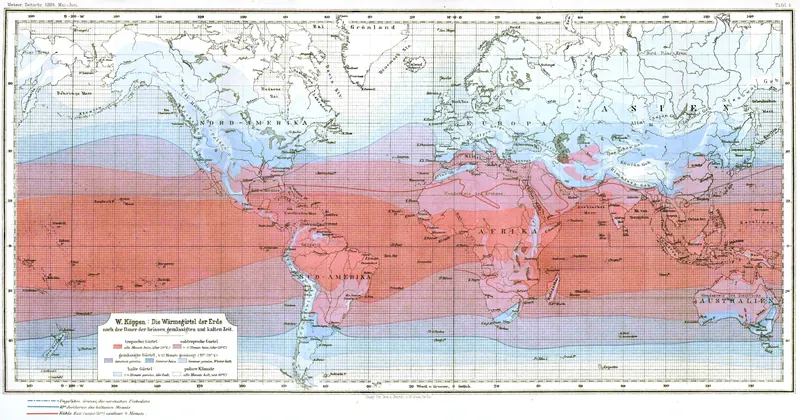
- 1884 Köppen first develops his climate classification. The climatologist Wladimir Köppen first developed his climate classification in 1884, and scientists all over the world still use versions of it. Met Office: Climate zones
- 1900 Köppen publishes his first full scheme. Köppen published his first full scheme in 1900 and a revised version in 1918, and kept revising it until he died in 1940. Encyclopaedia Britannica: Köppen climate classification
- 1918 Köppen publishes a revised version. Köppen published his first full scheme in 1900 and a revised version in 1918, and kept revising it until he died in 1940. Encyclopaedia Britannica: Köppen climate classification
- 1940 Köppen dies, still revising his system. Köppen published his first full scheme in 1900 and a revised version in 1918, and kept revising it until he died in 1940. Encyclopaedia Britannica: Köppen climate classification
- 1968 Trewartha’s An Introduction to Climate, 4th edition. The highland zone in Britannica’s rule table comes from G.T. Trewartha’s book An Introduction to Climate (4th edition, 1968). Encyclopaedia Britannica: Köppen climate classification
- 1983 Critchfield’s General Climatology, 4th edition. Britannica’s table of the rules is adapted from Critchfield’s General Climatology (1983) and a 2007 world map by Peel, Finlayson and McMahon. Encyclopaedia Britannica: Köppen climate classification
- 2007 An updated Köppen-Geiger world map by Peel and colleagues. In 2007 the scientists Peel, Finlayson and McMahon published an “Updated World Map of the Köppen-Geiger Climate Classification”. Encyclopaedia Britannica: Köppen climate classification
- 2018 Beck and colleagues’ climate zone paper. For the precise, up-to-date map of the zones and how they will change, the Met Office points to a 2018 paper by Beck and colleagues. Met Office: Climate zones
Think you’ve got it? Try the Climate Timeline game.
Next: myths vs facts →