Climate zones: why the world comes in five flavours.
Rainforests that get rain every month, deserts that freeze at night, a forest whose name means “land of the little sticks”. Here’s how scientists sort the world’s climates into zones, what the Köppen letters mean, and why London is so much milder than Canada at the same latitude. Every fact is checked against the Met Office, NOAA and Encyclopaedia Britannica.
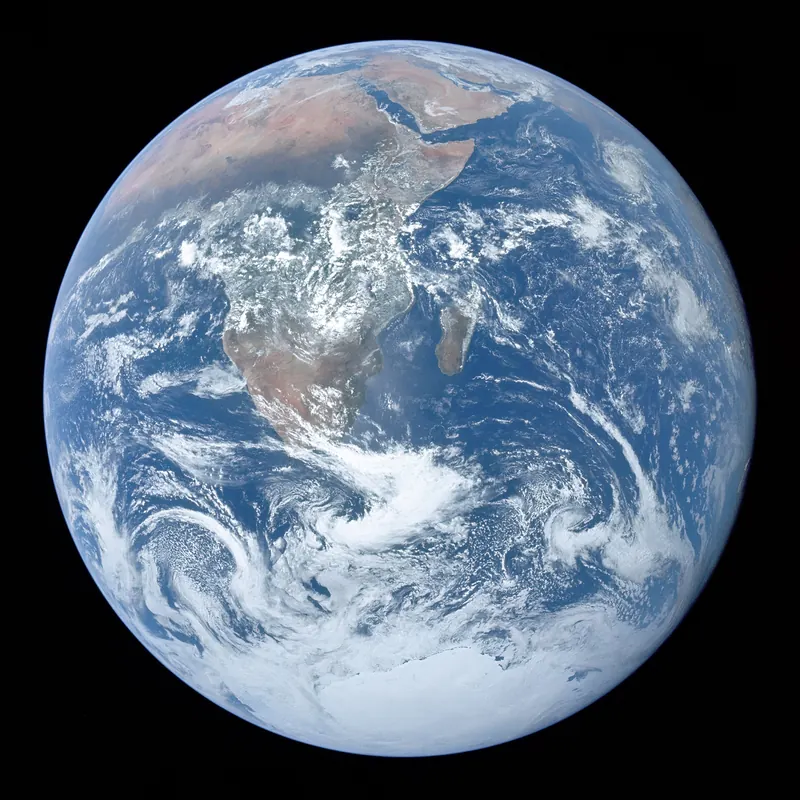
The Climate Maker
Slide the temperatures and the rain, and watch the Köppen code appear, with every step of the rules spelled out. Then switch to Challenge and try to build a hot desert, a tundra or the UK’s own Cfb.
The Maker is our own code. The rules come from Encyclopaedia Britannica’s Köppen table: Encyclopaedia Britannica: Köppen climate classification Encyclopaedia Britannica: Köppen climate classification Encyclopaedia Britannica: Köppen climate classification Encyclopaedia Britannica: Köppen climate classification
The short version
Climate zones are areas with distinct climates. They can follow weather patterns, latitude, or communities of plants and animals. Met Office: Climate zones
Köppen sorts climates into five main groups: tropical (A), dry (B), temperate (C), continental (D) and polar (E). Met Office: Climate zones Each group is then split up, first by when the rain falls in the year and then by temperature. Met Office: Climate zones
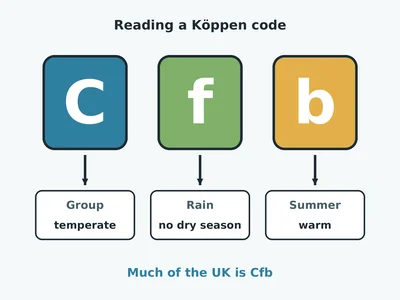
Much of the UK is Cfb: temperate (C), with no dry season (f) and a warm summer (b). Met Office: Climate zones
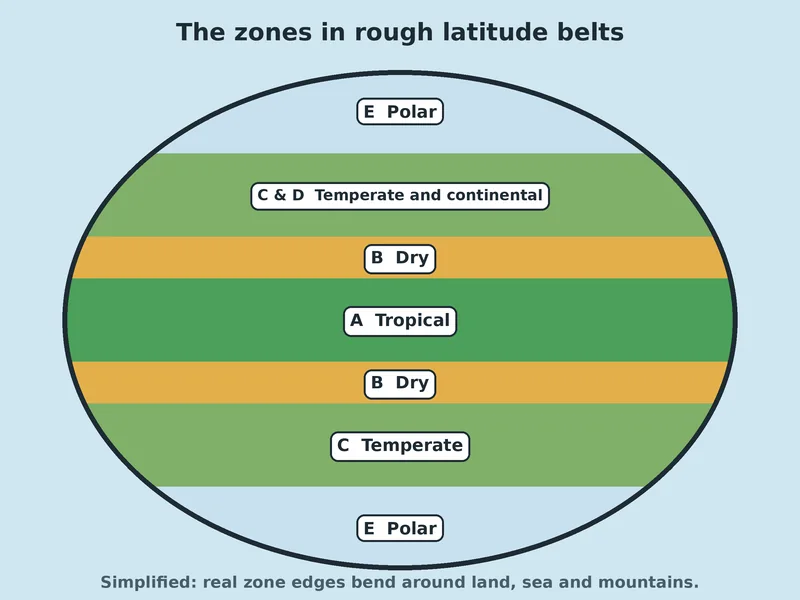
Roughly, the zones run by latitude: tropical near the equator, dry just north and south of the tropics, temperate beyond, and polar only in the Arctic and Antarctic. Met Office: Climate zones
Explore the zones
 What a zone isClimate, weather and microclimates.
 The Köppen lettersA, B, C, D, E and the rules.
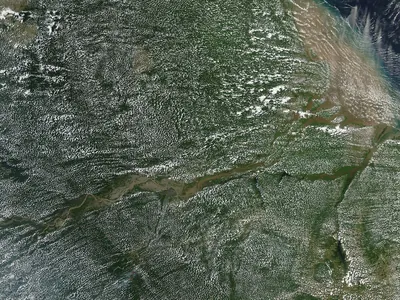 Tropical (A)Rainforest, monsoon, savanna.
 Dry (B)Deserts and steppes.
 Temperate (C)Mediterranean to drizzly west coasts.
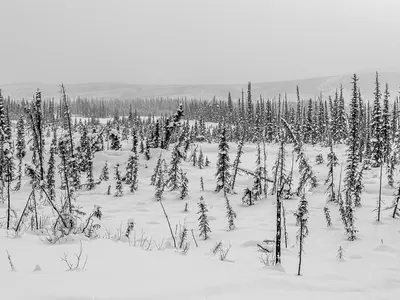 Continental (D)Hot summers, hard winters.
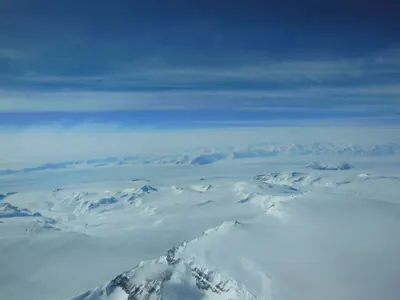 Polar & mountainTundra, ice caps and highlands.
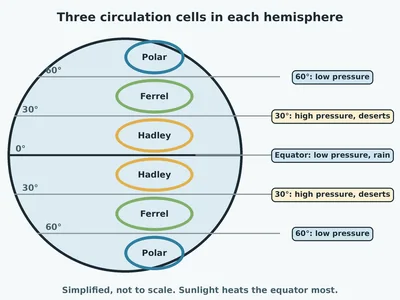 Why zones differSunlight, three cells, the sea.
 The UK & Isle of ManCfb, westerlies and frost hollows.
Tile pictures are credited on their pages and on the credits page.
Things to play
- The Climate MakerSlide the numbers, get a Köppen code, take the challenges.
- Which Zone?Ten clues. Is it A, B, C, D, E or H?
- Climate TimelineFrom Hadley’s cell in 1735 to the 2018 map.
- Climate Zones QuizTen questions at a time, every answer sourced.
- Landscape PairsMatch each landscape to its kind of climate.
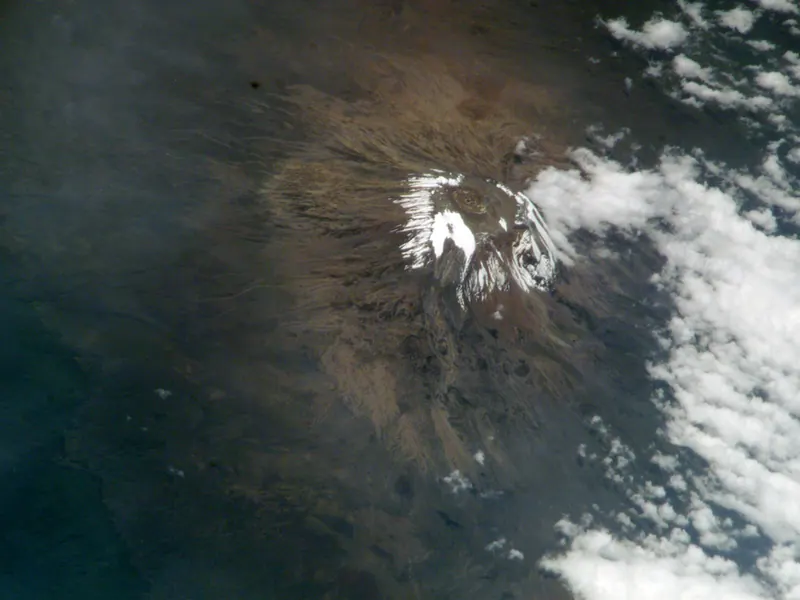
Enjoyed the trip round the world? Help keep this site going.
This site is hand-built, fact-checked and free to use. If the Climate Maker, a game or one of Useless’s notes made you grin, a little support keeps it going and helps the network grow.
Climate zones printables
Fact-checked PDFs in A4 and US Letter, sold as instant downloads from the ReallyByte store.
Colour the World’s Climate Zones: Map & Colouring Pack
Blank world and continent maps to colour by zone, a Köppen colour key, latitude-belt maps, a three-cell sheet, and landscape colouring pages for each zone
Köppen Code Puzzle Pack: Crosswords, Codes & Climate Logic
A crossword, a word search, a zone maze, a code-cracker, letter-matching and “classify this climate” logic puzzles, all with answer keys
Climate Zone Fact Cards: A to E and Mountains Too
Twenty-four fact-checked cards: the five Köppen groups, the highland group, the main climate types and four big causes, with the Köppen letters and rules
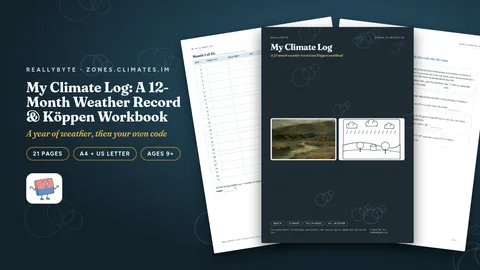
My Climate Log: A 12-Month Weather Record & Köppen Workbook
Record your own temperatures and rainfall for a year, then follow the Köppen rules step by step to work out your own climate code
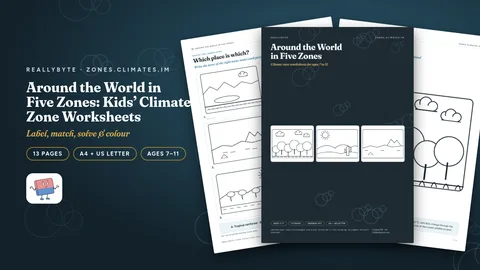
Around the World in Five Zones: Kids’ Climate Zone Worksheets
For ages 7 to 11: label the zones, match the landscapes, true or false, climate maths, a maze, colouring, a word search and riddles, with answer keys
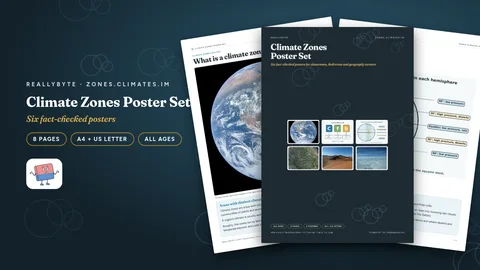
Climate Zones Poster Set
Six fact-checked posters: what a climate zone is, the Köppen letters, the three circulation cells, tropical, dry and polar zones
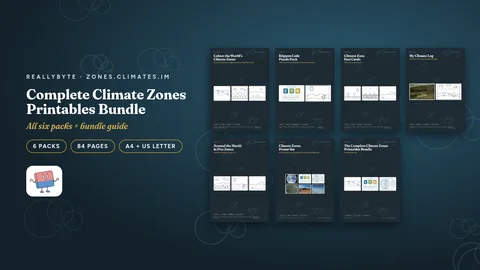 Best value
The Complete Climate Zones Printables Bundle
All six packs plus a guide, A4 and US Letter, in one download.