Dry climates
Too little rain for the heat. Deserts, steppes, and some very cold nights.
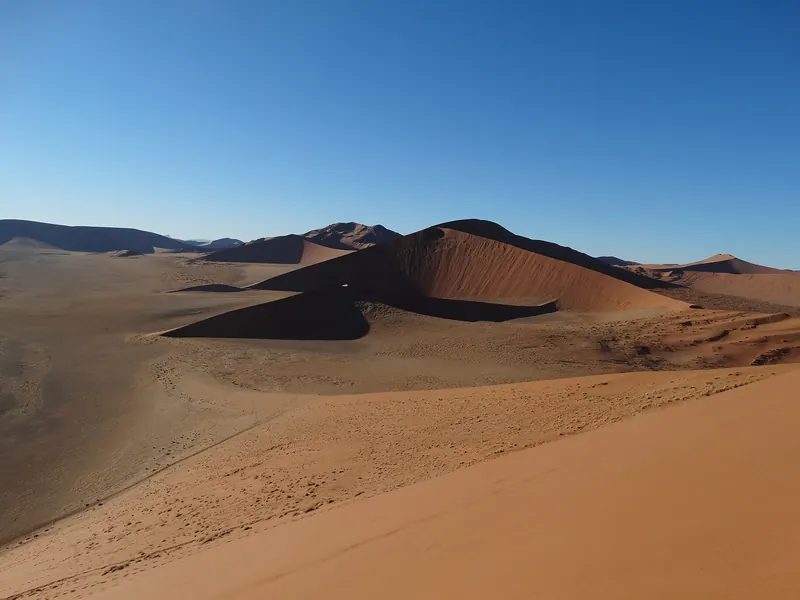
The dry belt
Dry and semi-dry climates cover about a quarter of Earth’s land, mostly in the belt between 15° and 30° latitude. Encyclopaedia Britannica: Köppen climate classification
Group B is the odd one out: it is defined by dryness, while every other group is defined by temperature. Encyclopaedia Britannica: Köppen climate classification Dry climates are split into arid (BW) and semi-arid (BS), with h added for warm and k for cold. Encyclopaedia Britannica: Köppen climate classification
Why deserts form
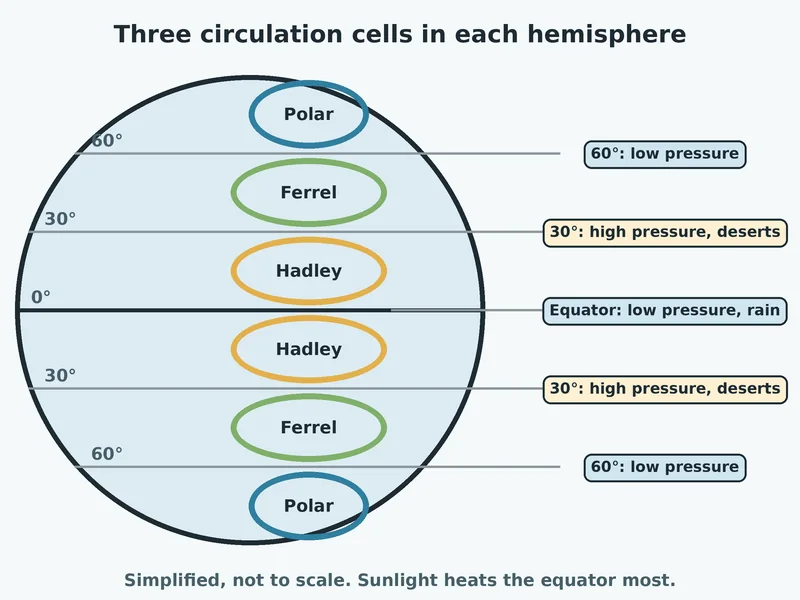
Sinking air on either side of the tropics makes near-permanent high pressure over the subtropics. Skies stay almost cloud-free all year, and deserts form. Met Office: Climate zones
Most of Earth’s true tropical deserts lie between 15° and 30° latitude, where the Hadley cell’s air comes down. Encyclopaedia Britannica: tropical and subtropical desert climate The driest deserts are best developed on the western sides of continents. Encyclopaedia Britannica: tropical and subtropical desert climate
Look at a globe and you’ll see lots of deserts along 30° north and south, including the American Southwest, northern Africa and Australia. NOAA JetStream: Global atmospheric circulations
Desert weather
Low-latitude deserts mostly get 0–25 cm of rain a year, but how unreliable it is matters more than the small totals. Encyclopaedia Britannica: tropical and subtropical desert climate A desert averaging 5 cm of rain over ten years might have had 50 cm in one wet year and almost none in the other nine. Encyclopaedia Britannica: tropical and subtropical desert climate
In some low-latitude deserts, fewer than 30 days a year have clouds. Encyclopaedia Britannica: tropical and subtropical desert climate
With no clouds to hold the heat in, deserts swing hugely between day and night: some of the hottest places on Earth drop below freezing at night. Met Office: Climate zones Desert days and nights can differ by 35 °C when daytime highs over 40 °C are followed by a fast night-time drop. Encyclopaedia Britannica: tropical and subtropical desert climate
Cold deserts
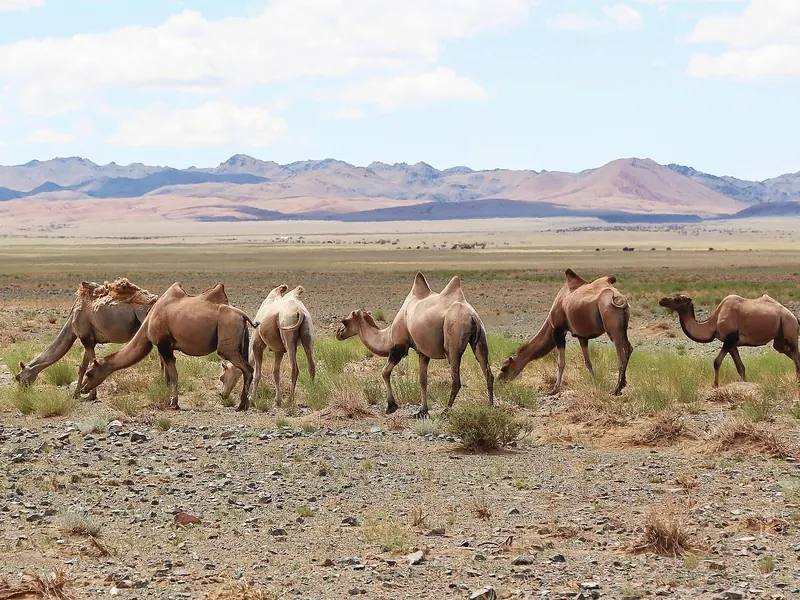
Not all deserts are hot. In the Gobi Desert of east Asia, the yearly average temperature can be below 0 °C. Met Office: Climate zones
Steppes (BS)
A steppe is a vast, treeless grassland that gets roughly 25–30 cm of rain a year. Encyclopaedia Britannica: steppe The word steppe comes from the Russian for “flat grassy plain”. Encyclopaedia Britannica: steppe
The great Eurasian Steppe stretches some 8,000 km, from Hungary through Ukraine and Central Asia to Manchuria. Encyclopaedia Britannica: steppe
Rain decides it: a bit less and a steppe turns to desert, a bit more and it becomes savanna or forest. Encyclopaedia Britannica: steppe
Next: temperate climates →